
Key Takeaways for Quick Implementation
- Stop using generic prompts; use "Role-Based" framing for better quality.
- AI is best for brainstorming and first drafts, not final publishing.
- Combine AI with a tight editorial process to avoid "robotic" brand voice.
- Use the tool for market research and persona mapping before writing a single word.
- Automate repetitive tasks like meta descriptions and ad variations to save hours.
Setting the Stage with AI-Powered Market Research
Before you launch a campaign, you need to know exactly who you're talking to. Usually, this involves hours of scrolling through forums or paying for expensive reports. Instead, you can use ChatGPT is a large language model developed by OpenAI that can analyze patterns in massive datasets to simulate user personas. By feeding it specific data about your industry, you can create a detailed map of your customer's pain points.
Try this: instead of asking "who is my target audience?", tell the AI, "Act as a customer researcher. I sell ergonomic chairs to remote software engineers in their 30s. List the top five frustrations they have with their current home office setup and the emotional trigger that makes them finally buy a new chair." This shifts the AI from a generic writer to a specialized consultant. You'll get specific insights, like the "lower back fatigue during 10-hour coding sprints," which you can then use as the primary hook in your ads.
Building a Content Engine That Doesn't Sound Robotic
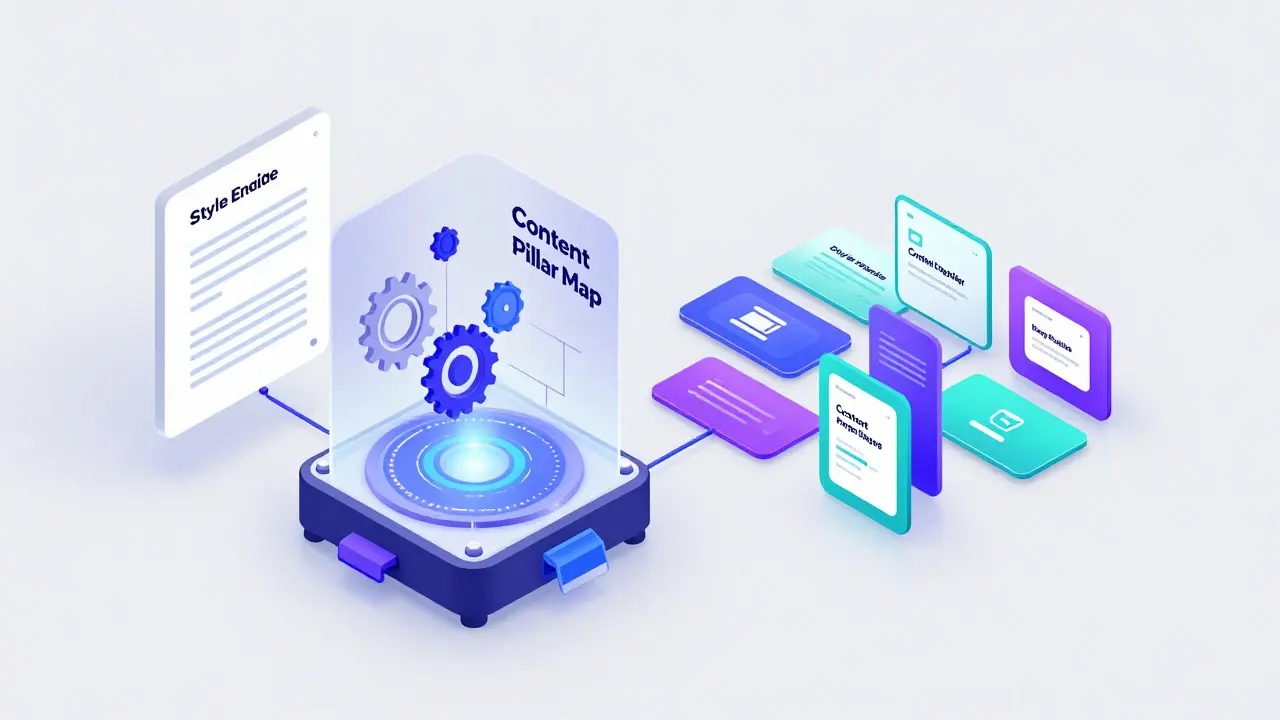
The biggest fear with AI is that your brand will sound like a bland manual. The trick is to separate the strategy from the execution. Use Content Marketing is a strategic approach focused on creating and distributing valuable, relevant, and consistent content to attract and retain a clearly defined audience. Start by asking the AI to build a content pillar map. If you're selling skincare, your pillars might be "Ingredients Science," "Daily Routines," and "Skin Type Guides."
Once the map is set, don't just ask for a post. Give it a Style Guide. Tell it: "Write in a conversational tone, avoid words like 'revolutionize' or 'tapestry,' use short sentences, and include a relatable example about a busy mom with no time for a 10-step routine." When you provide these constraints, the AI stops guessing and starts mimicking your actual brand voice. This turns a 30-minute struggle with a blank page into a 5-minute editing session.
| Approach | Method | Result Quality | Time Spent |
|---|---|---|---|
| The Lazy Way | "Write a 500-word blog about SEO" | Generic, robotic, often inaccurate | Low (but needs high rewrite) |
| The Pro Way | Role $\rightarrow$ Context $\rightarrow$ Constraint $\rightarrow$ Goal | Specific, brand-aligned, high conversion | Medium (setup takes time) |
Mastering Ad Copy and Conversion Optimization
Writing a single ad is easy; writing 50 variations for A/B testing is a nightmare. This is where Direct Response Marketing is a type of marketing designed to elicit an immediate response from the consumer, typically through a clear call to action (CTA). AI is a powerhouse for this because it can rapidly pivot between different psychological angles.
For a single product, ask the AI to generate copy based on different human drivers: fear of missing out (FOMO), the desire for status, or the need for efficiency. For example, one ad might focus on "Stop wasting 2 hours a day on manual data entry" (Efficiency), while another says "Join 5,000 top executives using this tool to lead their teams" (Status). By testing these variations on platforms like Meta Ads or Google Ads, you can find the exact emotional trigger that makes your audience click without spending weeks guessing.
Automating the Boring Stuff: SEO and Meta Data
Search Engine Optimization often feels like a chore because it requires so many repetitive micro-tasks. Creating Meta Descriptions is the short snippets of text that appear under a page title in search engine results pages (SERPs). Doing this for 100 pages is mind-numbing. Instead, feed the AI your page content and ask it to write three options for a meta description under 155 characters, including the primary keyword and a strong call to action.
You can also use it to generate Long-tail Keywords, which are longer and more specific keyword phrases that visitors are more likely to use when they're closer to a point of purchase. Ask the AI: "Based on the keyword 'organic dog food,' give me 10 question-based long-tail keywords that a first-time puppy owner would search for." This gives you a roadmap for an entire FAQ section or a series of helpful blog posts that capture high-intent traffic.

Developing a High-Conversion Email Sequence
Email is still the king of ROI, but most business owners send one "newsletter" a month and hope for the best. The real money is in the Welcome Sequence. This is the series of emails a user gets immediately after signing up. You can use AI to map out the psychological journey from "curious stranger" to "loyal customer."
- Email 1 (The Delivery): Give them the lead magnet and introduce the brand's mission.
- Email 2 (The Agitation): Talk about the problem they're facing and why it's frustrating.
- Email 3 (The Solution): Introduce your product as the bridge from their current pain to their desired state.
- Email 4 (The Proof): Share a case study or testimonial from a real client.
- Email 5 (The Hard Sell): Create a time-limited offer to push them toward the purchase.
When drafting these, tell the AI to use the AIDA Framework (Attention, Interest, Desire, Action). This ensures the email doesn't just provide information but actually drives the reader toward a specific goal. Instead of a generic "Buy Now," the AI can help you craft a "low-friction" CTA like "See how it works in 2 minutes."
Avoiding the AI Trap: The Human Quality Control
Here is the truth: if you publish AI content without editing it, your audience will know. AI has a tendency to be overly polite and uses predictable patterns. To maintain authority, you must implement a Human-in-the-Loop workflow. This means the AI does the heavy lifting (research, outlining, first draft), but a human provides the "soul" (personal anecdotes, strong opinions, and fact-checking).
Always verify any data or statistics the AI provides. While it's getting better, AI can still "hallucinate" or make up a convincing-sounding fact. A great rule of thumb is: use AI for the structure and the creative variations, but rely on your own experience for the truth and the nuance. This approach ensures you get the speed of a machine with the trust and credibility of a human expert.
Will using ChatGPT hurt my SEO rankings?
Google's guidelines focus on the quality and helpfulness of the content (E-E-A-T), not how it was produced. As long as your content provides genuine value, is accurate, and is edited by a human to ensure quality, using AI will not penalize your rankings. The risk only comes if you spam low-quality, unedited AI content.
How do I stop my AI content from sounding too generic?
The secret is in the prompt. Avoid simple requests like "write an article." Instead, provide a persona (e.g., "Act as a cynical tech reviewer"), a specific target audience, and a list of "forbidden words" that the AI commonly uses. Providing examples of your own previous writing as a reference also helps the AI mimic your specific cadence and tone.
Can ChatGPT actually perform market research?
It can't conduct live interviews, but it is incredible at synthesizing existing knowledge. It can help you identify common pain points, brainstorm user personas, and analyze competitors' strengths and weaknesses based on the massive amount of public data it was trained on. It's a great starting point to form hypotheses that you can then validate with real customers.
What is the best way to use AI for social media?
Use AI to turn one long-form piece of content into multiple short-form assets. For example, a blog post can be turned into a Twitter thread, three LinkedIn posts, and a script for a TikTok video. Ask the AI to "repurpose this article for LinkedIn, focusing on a professional tone and adding a provocative question at the end to encourage comments."
Do I need a paid subscription for marketing purposes?
While the free version is capable, the paid versions usually offer better reasoning, access to more recent data, and the ability to upload files (like PDFs of your brand guidelines or spreadsheets of customer data). For professional marketers, the increased accuracy and advanced features make the subscription a high-ROI investment.
Next Steps for Your AI Integration
If you're feeling overwhelmed, don't try to automate everything at once. Start with one small win. Try automating your meta descriptions for next week's posts or using the AI to brainstorm five new hooks for your best-performing ad. Once you see the time savings, move on to more complex tasks like persona mapping or email sequences.
If you hit a wall where the AI just isn't "getting" your brand, try the Reverse Prompting technique. Paste a piece of your best writing into the tool and ask, "Analyze the tone, style, and structure of this text. Create a detailed prompt that I can use in the future to ensure you write in this exact voice." Now you have a reusable key to unlock high-quality, brand-consistent content every time you start a new session.



Write a comment