
Remember the last time you walked into a shop that didn’t have a website? It probably felt like stepping back in time. In 2026, if your business isn’t visible online, it effectively doesn’t exist to most of your potential customers. This isn’t just about having a Facebook page anymore; it’s about survival. Digital Marketing is the strategic use of online channels to connect with current and prospective customers. It has evolved from a nice-to-have add-on into the central nervous system of modern commerce.
The landscape has shifted dramatically. We are no longer talking about simple banner ads or basic SEO tweaks. Today, digital marketing is an integrated ecosystem involving artificial intelligence, hyper-personalization, and real-time data analytics. If you’re still relying on print flyers or cold calling as your primary growth engine, you’re fighting a losing battle against competitors who can reach their ideal customer while they’re scrolling through their morning news feed.
Why Digital Marketing Is Non-Negotiable for Survival
Let’s get straight to the point: visibility equals viability. In a saturated market, being invisible is a death sentence. But why is this so critical right now? Because consumer behavior has permanently migrated online. According to recent data, over 85% of all B2B research starts with a search engine query. For B2C, that number is even higher.
Search Engine Optimization (SEO) is the practice of optimizing content to rank higher in organic search results. When someone needs a plumber, a consultant, or a new pair of running shoes, they don’t ask a neighbor first; they ask Google. If you aren’t on that first page, you’ve already lost the lead. This isn’t about vanity metrics; it’s about capturing intent at the exact moment it happens.
Consider the cost efficiency. Traditional advertising-billboards, TV spots, radio ads-is expensive and often untargeted. You pay for eyeballs that might not care about your product. Digital marketing allows you to spend money only when someone clicks, engages, or converts. This precision means smaller businesses can compete with giants by targeting niche audiences with laser focus.
The Core Pillars of a Surviving Strategy
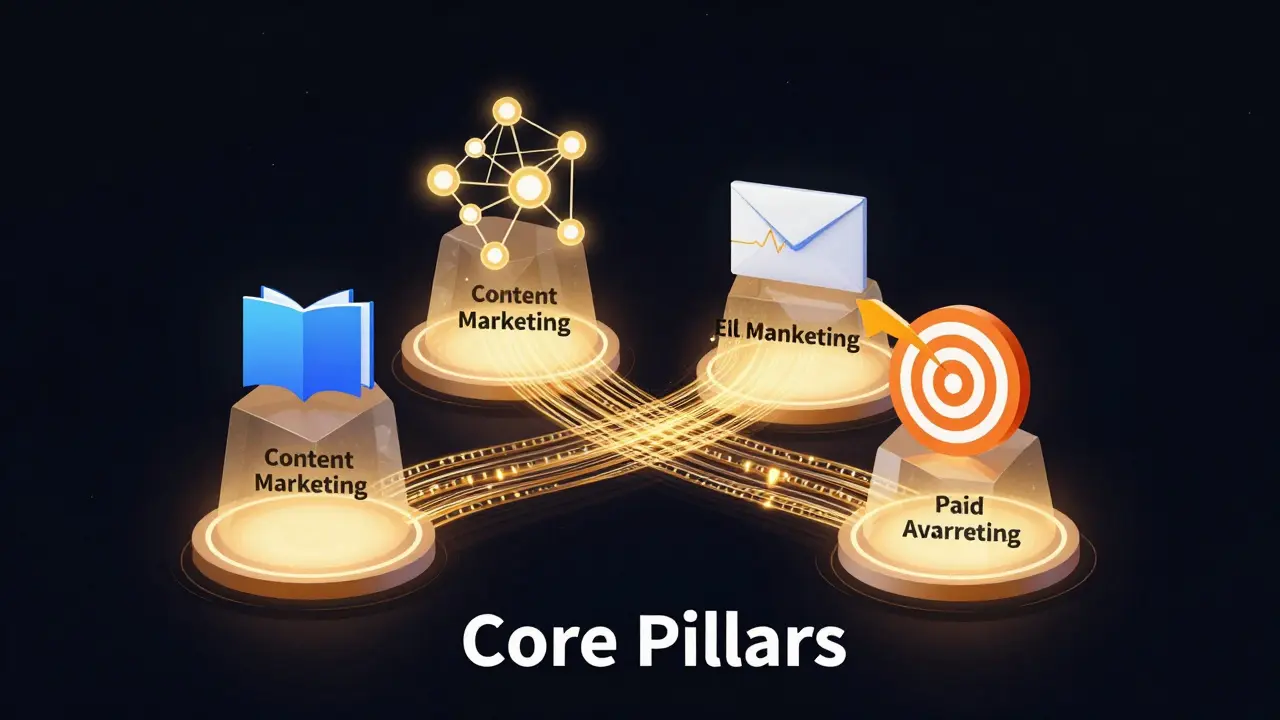
You can’t boil the ocean. To survive and thrive, you need to master a few core pillars. These aren’t optional extras; they are the foundation of your digital presence.
- Content Marketing: Creating valuable, relevant information that attracts and retains a clearly defined audience. Think blog posts, videos, and podcasts that solve problems, not just sell products.
- Social Media Marketing: Engaging with communities on platforms where your customers hang out. In 2026, short-form video on platforms like TikTok and Instagram Reels dominates attention spans.
- Email Marketing: Owning your audience list. Unlike social media algorithms, email goes directly to your customer’s inbox. It remains one of the highest ROI channels available.
- Paid Advertising (PPC): Using platforms like Google Ads or Meta Ads to drive immediate traffic. This is fuel for the fire when organic growth takes too long.
Each pillar supports the others. A great blog post (Content) can be shared on LinkedIn (Social), promoted via an ad (PPC), and used to grow your newsletter list (Email). Integration is key.
Data-Driven Decisions: The Heartbeat of Modern Marketing
Gone are the days of guessing what works. Today, every click, scroll, and purchase is tracked. Marketing Analytics is the measurement, collection, analysis, and reporting of web data to understand and optimize web marketing. Without data, you’re driving blindfolded.
Tools like Google Analytics 4 provide deep insights into user behavior. Are people bouncing off your landing page? Is your checkout process too complex? Data tells you exactly where the leaks are in your funnel. Instead of saying “I think we should try Instagram,” you say, “Our demographic data shows 60% of our target audience spends 30+ minutes daily on Instagram, and our engagement rate there is 4x higher than on Twitter.”
This shift from intuition to evidence-based strategy reduces waste. You stop spending budget on channels that don’t convert and double down on those that do. For a small business operating on thin margins, this efficiency can mean the difference between profit and loss.
Personalization at Scale with AI
Here’s the hard truth: generic messaging is dead. Customers expect brands to know them. They want recommendations that feel curated, not broadcasted. This is where Artificial Intelligence in Marketing is the use of machine learning algorithms to automate and personalize customer interactions.
In 2026, AI tools can analyze past purchase history, browsing behavior, and even time-of-day preferences to deliver personalized emails, product suggestions, and ad creatives automatically. Imagine a clothing brand sending a discount code for winter coats to a customer in Melbourne because the weather forecast predicts a cold snap, while sending swimwear deals to a customer in Queensland. That’s not magic; it’s programmatic personalization.
Chatbots powered by natural language processing handle customer service inquiries instantly, freeing up human staff for complex issues. AI-driven content generation helps create variations of headlines and descriptions to test which performs best. The result? A smoother customer journey that feels bespoke, even though it’s automated.
| Feature | Traditional Marketing | Digital Marketing |
|---|---|---|
| Targeting Precision | Broad, geographic-based | Hyper-specific, interest & behavior-based |
| Cost Structure | High upfront costs, fixed | Flexible budgets, pay-per-performance |
| Measurability | Difficult, estimated reach | Real-time, precise conversion tracking |
| Customer Interaction | One-way communication | Two-way, interactive engagement |
| Adaptability | Slow, static campaigns | Instant adjustments based on data |
Building Trust Through Authenticity
Survival isn’t just about acquiring customers; it’s about keeping them. In an era of skepticism toward big corporations, authenticity wins. People buy from people. Your digital voice should reflect your brand’s personality-whether that’s professional, quirky, or empathetic.
User-generated content (UGC) plays a huge role here. Encouraging customers to share photos of your product or write reviews builds social proof faster than any polished ad copy. A genuine five-star review from a local customer carries more weight than a glossy brochure. Responding to comments, acknowledging complaints publicly, and showing behind-the-scenes glimpses humanizes your brand.
Transparency is also crucial. If you make a mistake, own it. If your shipping is delayed, communicate proactively. Digital channels allow for rapid crisis management. Silence breeds rumors; transparency builds loyalty.
Common Pitfalls That Sink Businesses
Even with the best tools, many businesses fail in their digital transition. Here’s what to avoid:
- Trying to Be Everywhere: You don’t need to be on TikTok, LinkedIn, Pinterest, and X simultaneously. Pick the platforms where your audience actually lives. Quality over quantity.
- Neglecting Mobile Optimization: More than 70% of web traffic comes from mobile devices. If your site loads slowly or looks broken on a phone, you’re losing sales instantly.
- Ignoring SEO Basics: Fancy design means nothing if no one can find you. Invest in keyword research and technical SEO early on.
- Set-and-Forget Mentality: Digital marketing requires constant tweaking. Algorithms change, trends shift, and competitor strategies evolve. Regular audits are essential.
- Focusing Only on Acquisition: Acquiring a new customer costs five times more than retaining an existing one. Don’t neglect email nurturing and loyalty programs.
The Future-Proof Mindset
Digital marketing isn’t a destination; it’s a continuous journey. What worked in 2024 might be obsolete in 2026. The rise of voice search, augmented reality shopping experiences, and privacy-first tracking regulations require agility. Businesses that survive are those that view marketing as a learning lab. Test, measure, learn, and repeat.
Start small if you have to. Create a simple landing page. Write one helpful blog post. Run a $10 ad campaign. Measure the results. Then scale what works. The ultimate weapon isn’t a specific tool or platform; it’s the willingness to adapt and engage with your customers where they are.
Is digital marketing really necessary for small local businesses?
Absolutely. Even if you serve a local area, your customers search online first. A strong local SEO presence ensures you appear in "near me" searches. Without it, you’re invisible to anyone who doesn’t already know your physical address.
How much should a business spend on digital marketing?
There’s no fixed rule, but a common benchmark is 7-10% of total revenue for established businesses and 10-15% for startups looking to grow rapidly. Start with a modest budget, track ROI closely, and increase spend on channels that generate positive returns.
Can I do digital marketing myself, or do I need an agency?
You can start DIY, especially for content creation and basic social media. However, for paid advertising, advanced SEO, and data analytics, specialized skills are often required. Many businesses hire freelancers or agencies once they’ve exhausted their internal capacity or need expert optimization.
What is the biggest mistake beginners make in digital marketing?
Expecting overnight results. Digital marketing is a marathon, not a sprint. SEO takes months to show significant traction, and building an engaged email list requires consistent effort. Patience and consistency are far more valuable than chasing viral hacks.
How does AI impact my daily marketing tasks?
AI automates repetitive tasks like scheduling posts, segmenting email lists, and generating ad copy variations. It frees up your time to focus on strategy, creativity, and customer relationships. Think of AI as a powerful assistant, not a replacement for human insight.



Write a comment