
Stop fighting the AI wave and start riding it
Most people treat AI like a magic button: they type "write me an SEO blog post," hit enter, and wonder why their traffic hasn't exploded. Here is the truth: Google doesn't penalize AI content just because it's AI; it penalizes low-effort, generic fluff that adds zero value to the reader. If you use AI to replace your brain, you've already lost. But if you use it to supercharge your research and structure, you're playing a different game.
To actually move the needle, you need to stop thinking about ChatGPT for SEO as a writer and start seeing it as a highly efficient research assistant. The real potential lies in the intersection of human expertise and machine speed. Let's look at how to actually implement this without getting your site flagged for spam.
Quick Wins for AI SEO Implementation
- Keyword Clustering: Turn a list of 500 raw keywords into 10 logical content hubs in seconds.
- Search Intent Mapping: Determine if a user wants to buy, learn, or find a specific page.
- Schema Generation: Create complex JSON-LD code without writing a single line of manual script.
- Meta-Data Scaling: Draft 50 unique, click-worthy meta descriptions based on page content.
Mastering the Art of Keyword Intelligence
Traditional keyword research involves staring at spreadsheets for hours. ChatGPT is a large language model developed by OpenAI that can process and categorize vast amounts of text data. By leveraging its ability to recognize patterns, you can move from "keyword hunting" to "topic mapping."
Instead of asking for "keywords for coffee shops," try feeding the AI a list of your competitors' top-performing pages. Ask it to identify the "semantic gaps"-the questions users are asking that your competitors are ignoring. For example, if everyone is talking about "best espresso machines," but no one is explaining "how to calibrate a burr grinder for light roast beans," you've found a high-value, low-competition entry point.
Use the AI to build a Topic Cluster, which is a strategy where a single "pillar page" covers a broad topic and is supported by several detailed "cluster pages". This tells search engines you have deep authority on the subject, not just a few random posts.
| Task | Manual Approach | AI-Enhanced Approach |
|---|---|---|
| Categorization | Manual tagging in Excel (Hours) | Prompt-based clustering (Seconds) |
| Intent Analysis | Guessing based on search volume | Analyzing linguistic modifiers (Seconds) |
| Gap Analysis | Reading 20+ competitor articles | Comparative content analysis via AI (Minutes) |
Writing Content That Doesn't Smell Like a Bot
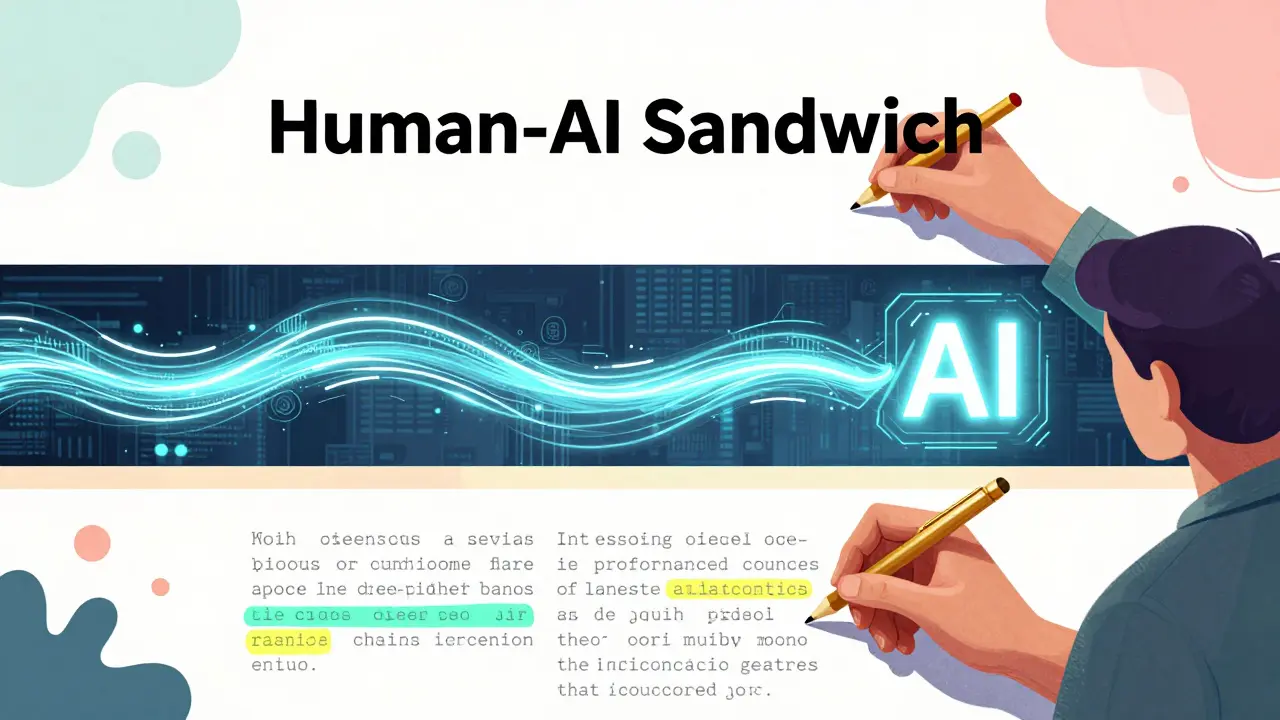
The biggest mistake is using the first draft. AI tends to use words like "delve," "unlock," and "comprehensive guide," which act as red flags for both readers and algorithms. To win, you need to implement the "Human-AI Sandwich" method: Human Strategy $\rightarrow$ AI Drafting $\rightarrow$ Human Refinement.
Start by providing the AI with your unique perspective. Give it a real-world case study, a controversial opinion, or a specific data point from your business. If you're writing about Content Marketing, don't let the AI say "Content is king." Instead, tell it: "I've found that long-form guides only work if they have a calculator tool embedded." Now the AI is working with a unique angle, not just repeating the internet's average opinion.
Focus on E-E-A-T, which stands for Experience, Expertise, Authoritativeness, and Trustworthiness. This is the gold standard for Google Search's quality evaluator guidelines. AI cannot provide "Experience." It hasn't actually used the product or felt the frustration of a failing software update. You must inject your own stories and first-hand evidence into every section.
Technical SEO and the AI Shortcut
You don't need to be a developer to handle the technical side of SEO anymore. JSON-LD is a specific format of JavaScript used to provide structured data to search engines. Writing this by hand is tedious and prone to errors. Instead, paste your page content into the AI and ask it to "Generate FAQ Schema in JSON-LD format based on this text."
You can also use AI to write Regular Expressions (RegEx) for Google Search Console. If you want to find all your "how-to" queries that have a high impression count but low click-through rate, the AI can write the exact RegEx string you need to filter your data. This turns a three-hour data project into a five-minute task.
Another hidden gem is the use of AI for Internal Linking strategies. By feeding the AI a list of your existing URLs and the content of a new post, you can ask it to suggest the most logically relevant anchor text and destination pages. This improves the crawlability of your site and passes "link juice" more effectively.

Avoiding the AI Quality Trap
There is a dangerous temptation to scale content production from 4 posts a month to 40. When you do this, you often dilute your brand's voice and risk a "helpful content' update hit. The goal isn't more content; it's more *effective* content.
Set up a strict quality checklist. If an AI-generated paragraph doesn't provide a new insight, a specific example, or a helpful tip, delete it. Ask yourself: "Would a human spend three minutes reading this, or is this just filler?" If it's filler, the search engine will eventually notice that users are bouncing from your page, and your rankings will drop.
Keep an eye on Search Generative Experience (SGE), which is Google's integration of AI directly into the search results page. As SGE provides direct answers, the "informational" traffic for simple questions will vanish. To survive, your content must move toward "opinionated" and "experiential" content-things an AI cannot simulate because it lacks a physical existence in the real world.
Will using ChatGPT for SEO get my site penalized by Google?
No, Google has explicitly stated that they reward high-quality content regardless of how it is produced. However, they penalize "spammy" content created primarily for search engines rather than humans. If your AI content is generic and lacks original insight, it may be flagged as low-quality.
How do I make AI content pass as human?
The key is adding "information gain." This means adding data, personal stories, specific case studies, and unique opinions that aren't present in the AI's training data. Edit out common AI words and restructure the flow to match a natural human conversation.
What is the best prompt for keyword research?
Avoid simple prompts. Instead, use a persona-based prompt: "Act as a senior SEO strategist with 15 years of experience. Analyze this list of keywords and group them by search intent (Informational, Transactional, Navigational) and identify the most underserved user pain point."
Can AI handle technical SEO audits?
AI cannot crawl your website in real-time like a tool such as Screaming Frog. However, it is excellent at interpreting the data from those tools. You can paste a list of 404 errors or slow-loading pages, and the AI can help you prioritize which ones to fix first based on the URL structure.
How does SGE affect AI-written content?
SGE answers simple queries directly on the search page, meaning "What is..." articles will lose traffic. To counter this, focus on "How to solve [Specific Complex Problem]" articles, where the user needs a detailed, expert-led walkthrough that a short AI summary cannot provide.
Next Steps for Your AI SEO Workflow
If you are just starting, don't try to automate everything at once. Start by using AI for the "boring" parts of SEO: creating meta tags, drafting basic outlines, and generating schema. Once you've mastered the prompting process, move into using it for deeper competitive analysis.
For those with established sites, run a "content audit" using AI. Feed the AI your lowest-performing pages and ask it to identify why they aren't converting or ranking. Is the intent wrong? Is the content too thin? Use the AI to brainstorm a "refresh plan" to bring those pages back to life with updated data and better structure.



Write a comment