
Remember when writing a single email campaign took all morning? Now, generating hundreds of ad variations takes seconds. That shift isn't just about speed; it's about scale and precision. For marketers, ChatGPT is an advanced artificial intelligence tool that generates human-like text to automate content creation, customer service, and data analysis. In 2026, it has moved from a novelty to the backbone of modern advertising strategies. If you are still writing every headline by hand, you are leaving money on the table. This guide cuts through the hype to show you exactly how to deploy ChatGPT for better ROI, sharper messaging, and faster campaigns.
Why Advertisers Are Betting Big on Generative AI
The advertising landscape changed drastically between 2024 and 2026. Platforms like Meta and Google raised their stakes on automated bidding and creative testing. The old model of "write one post, hope it goes viral" is dead. Today, success comes from volume, iteration, and data-driven refinement. ChatGPT fits perfectly into this new reality because it removes the bottleneck of human creativity fatigue.
Consider the math. A traditional team might produce ten unique ad concepts in a week. With ChatGPT, you can generate fifty distinct angles in an hour. This doesn't mean quality drops; it means you have more raw material to test. You can run A/B tests on micro-variations-changing just the call-to-action or the emotional hook-that would have been too tedious to write manually. The result is higher conversion rates because you find the winning message faster.
Moreover, digital marketing budgets are tighter. Agencies are expected to do more with less. AI tools allow small teams to punch above their weight class. You aren't replacing your copywriters; you are giving them superpowers. They move from being word-smiths to strategy directors, curating the best outputs from the AI rather than starting from a blank page.
Core Use Cases for ChatGPT in Advertising
To get real value, you need to know where ChatGPT shines and where it struggles. It excels at structure, variation, and ideation. Here are the four pillars of AI-assisted advertising:
- Copywriting at Scale: Generating headlines, body copy, and calls-to-action for social media, search ads, and display banners.
- Audience Persona Development: Creating detailed buyer personas based on demographic data and pain points to tailor messaging.
- Content Repurposing: Turning a long-form blog post into ten Twitter threads, three LinkedIn articles, and five email newsletters.
- Creative Strategy Brainstorming: Ideating campaign themes, slogans, and visual concepts before production begins.
Let's look at copywriting specifically. This is the bread and butter. Instead of asking ChatGPT to "write an ad," you provide context. You feed it the product features, the target audience's objections, and the desired tone. The AI then produces multiple options. Your job is to select the strongest ones and refine them. This process reduces writer's block and ensures consistency across channels.
The Art of Prompt Engineering for Ads
Garbage in, garbage out. If you give ChatGPT vague instructions, you get generic ads that sound like everyone else's. To win, you must master prompt engineering. Think of your prompt as a brief for a junior copywriter, but infinitely more detailed.
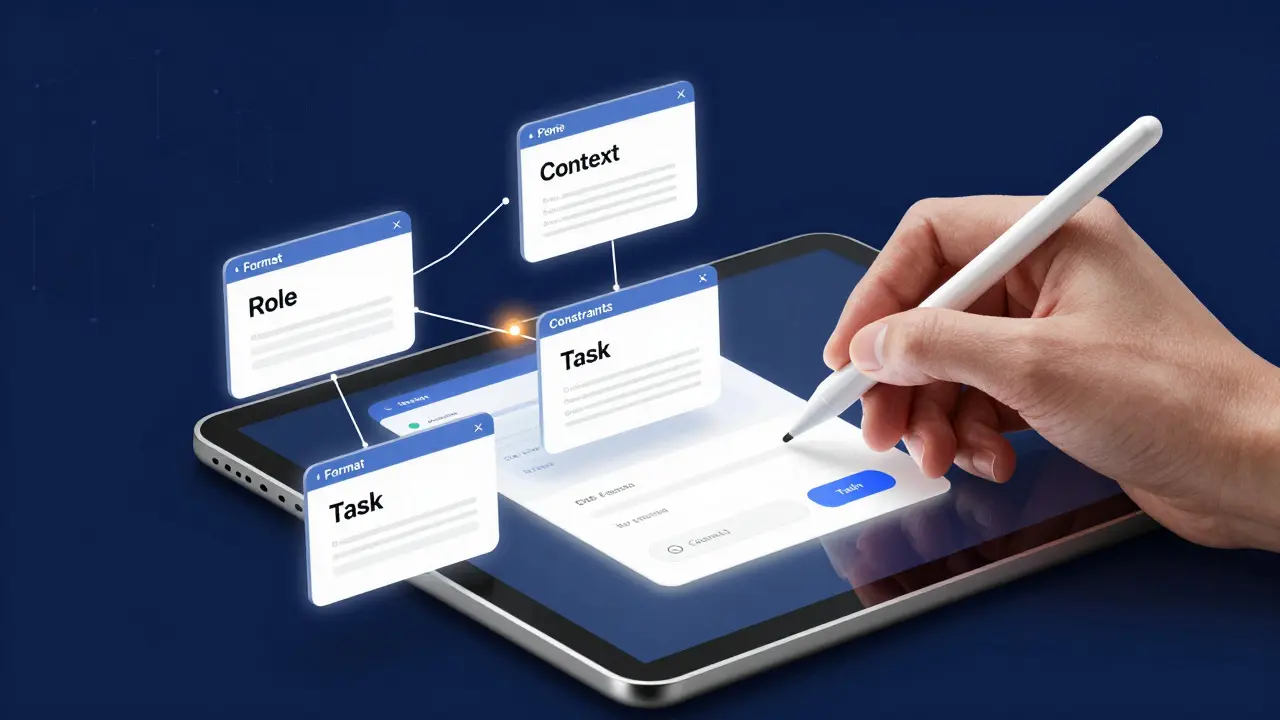
A strong prompt includes five elements: Role, Context, Task, Constraints, and Format. For example, don't say "Write an Instagram caption." Say: "Act as a senior copywriter for a luxury skincare brand. Write three Instagram captions targeting women aged 35-50 who are concerned about aging. Highlight our new retinol serum. Keep the tone empathetic and scientific. Include a clear call-to-action to book a consultation. Output in a bulleted list." This level of detail forces the AI to narrow its focus. It prevents fluffy language and ensures the output aligns with your brand voice. Over time, you will develop a library of reusable prompt templates for different campaign types. This standardizes your workflow and improves quality control.
Integrating ChatGPT Into Your Workflow
You don't use ChatGPT in isolation. It works best when integrated into your broader marketing tech stack. In 2026, most major platforms offer native AI assistants, but ChatGPT remains the most flexible due to its large language model capabilities.
| Tool Type | Best For | Limitations | Integration Level |
|---|---|---|---|
| ChatGPT (Standalone) | Ideation, drafting, complex reasoning | No direct access to live ad account data | Manual copy-paste or API |
| Platform-Native AI (e.g., Meta Advantage+) | Bidding optimization, auto-generated assets | Black box algorithms, less control over creative | Fully integrated |
| CRM-AI Plugins | Personalized email sequences | Limited to customer database scope | High |
Start by using ChatGPT for the pre-production phase. Draft your scripts and copy here. Then, move the approved content into your design tools. Many graphic design platforms now have AI plugins that can take your ChatGPT-generated text and apply it to templates automatically. This creates a seamless pipeline from idea to launch.
For larger teams, consider using APIs to connect ChatGPT directly to your CMS or ad management software. This allows for dynamic content generation at scale. Imagine a retail site that automatically writes unique product descriptions for thousands of SKUs based on supplier data. That is the power of API integration.
Maintaining Brand Voice and Authenticity
The biggest risk with AI is sounding robotic. Consumers are savvy; they can spot generic AI writing from a mile away. To avoid this, you must train ChatGPT on your specific brand voice. Upload your style guide, past successful campaigns, and brand values into the chat context. Ask the AI to mimic those examples closely.
Even then, human oversight is non-negotiable. Always review AI output for nuance, cultural sensitivity, and factual accuracy. AI can hallucinate facts or miss subtle sarcasm. Your role is to add the "human touch"-the empathy, humor, and local references that resonate deeply with your audience. Think of AI as the engine and your brand team as the steering wheel.

Measuring Success and Iterating
How do you know if ChatGPT is actually helping? Look at the metrics that matter: Click-Through Rate (CTR), Conversion Rate, and Cost Per Acquisition (CPA). Run controlled experiments. Create two sets of ads: one written entirely by humans, one drafted by ChatGPT and refined by humans. Compare the performance over a two-week period.
In most cases, the AI-assisted ads perform better because they benefit from rapid iteration. You can test more variables. But remember, correlation is not causation. Ensure other factors like budget and targeting remain constant. Use the data to refine your prompts. If certain tones or structures consistently win, encode those preferences into your future prompts. This creates a feedback loop that makes your AI smarter over time.
Ethical Considerations and Compliance
As AI becomes ubiquitous, regulations are tightening. In 2026, many regions require disclosure of AI-generated content, especially in political or financial advertising. Check your local laws. Transparency builds trust. If you use AI, consider adding a subtle disclaimer or ensuring your content passes rigorous fact-checking.
Also, be mindful of copyright issues. While ChatGPT generates original text, it was trained on existing data. Avoid prompting it to replicate specific copyrighted works or trademarks. Stick to general styles and ideas. This protects your brand from legal headaches down the road.
Future-Proofing Your Marketing Strategy
ChatGPT is not a static tool. It evolves monthly. New models bring better reasoning, multimodal capabilities (text, image, video), and deeper personalization. To stay ahead, keep learning. Experiment with new features as they roll out. Attend webinars, join marketer communities, and share insights with your team.
The marketers who thrive in 2026 and beyond are those who blend AI efficiency with human creativity. They use tools like ChatGPT to handle the heavy lifting of content production, freeing themselves to focus on strategy, relationships, and innovation. Embrace the change, but never lose sight of the human element. That is where true connection happens.
Can ChatGPT replace professional copywriters?
No. ChatGPT is a tool, not a replacement. It excels at generating drafts and variations quickly, but it lacks strategic insight, brand intuition, and emotional depth. Professional copywriters use ChatGPT to accelerate their workflow, allowing them to focus on high-level strategy and creative direction rather than getting stuck on first drafts.
Is AI-generated ad copy allowed on platforms like Facebook and Google?
Yes, both Meta and Google allow AI-generated content, provided it adheres to their advertising policies regarding truthfulness, non-deceptive practices, and prohibited content. However, some regions may require disclosure that the content was AI-generated. Always check the latest platform guidelines and local regulations to ensure compliance.
How do I prevent ChatGPT from producing generic or boring ads?
Avoid generic results by using highly specific prompts. Include details about your target audience's pain points, your brand's unique selling proposition, and the desired tone. Provide examples of previous successful ads. You can also ask ChatGPT to adopt a specific persona or style, such as "witty," "authoritative," or "conversational," to steer the output away from blandness.
What are the best practices for integrating ChatGPT into an agency workflow?
Start by creating standardized prompt templates for common tasks like social media posts, email subject lines, and landing page headers. Train your team on prompt engineering techniques. Establish a review process where human editors always refine AI output for brand voice and accuracy. Finally, track performance metrics to see which AI-assisted content performs best and iterate on your prompts accordingly.
Does using ChatGPT reduce the cost of advertising campaigns?
Indirectly, yes. By speeding up content creation and enabling rapid A/B testing, ChatGPT helps you find winning ads faster, reducing wasted ad spend on underperforming creatives. It also allows smaller teams to produce more content without hiring additional staff, lowering operational costs. However, the primary benefit is improved efficiency and performance, not just direct cost savings.



Write a comment